
Middlesex Canal Association P.O. Box 333 Billerica, Massachusetts 01821
www.middlesexcanal.org
Middlesex Canal Association P.O. Box 333 Billerica, Massachusetts 01821
www.middlesexcanal.org
| Volume 64 No. 1 | October 2025 |
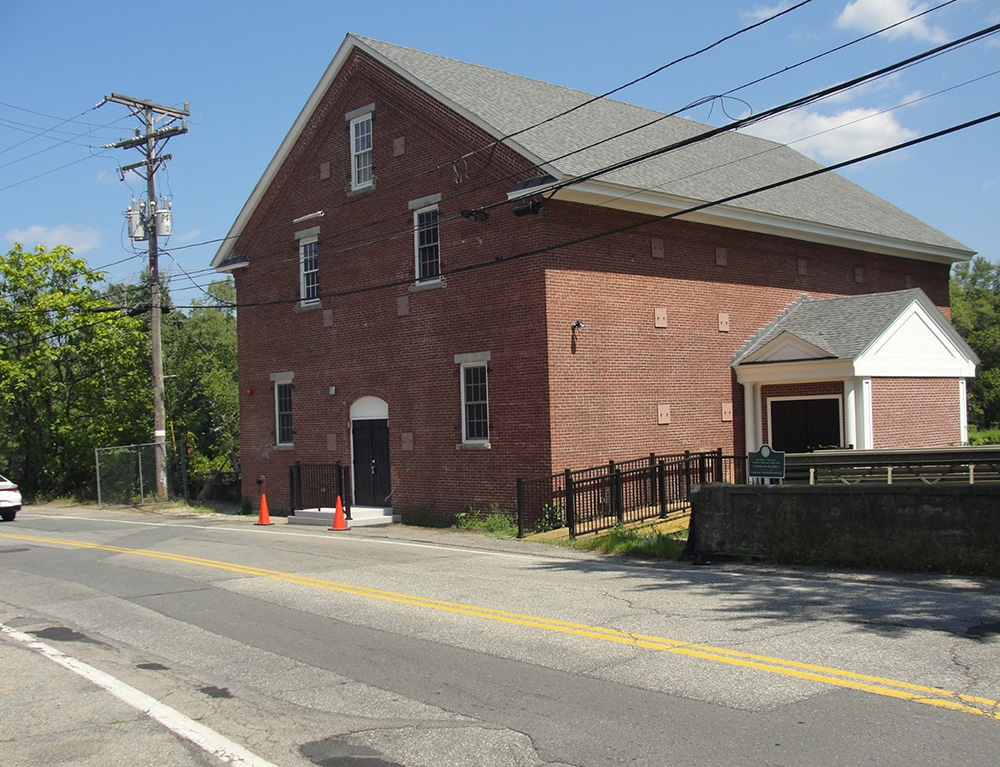
The Middlesex Canal Museum will soon be moving to this new location a 2 Old Elm Street in North Billerica.
The nearly complete building is pictured here in late August of 2025.
TABLE OF CONTENTS
MCA Sponsored Events / Directions to MCA Museum and Visitors’ Center
President’s Message: “Mr. Blood and Captain Kirk” – by J. Breen
“It’s Been a Long Time Coming” by Betty Bigwood
HOW LONG DID IT TAKE? by Bill Gerber
“About Tom Dahill” by Howard Winkler
“Portuguese Lock” by Debra Fox
Editors’ Letter
Hello Readers!
Welcome to the Fall 2025 issue of Towpath Topics! The good news? In the next issue we may be reporting on the grand opening of the new Middlesex Canal Museum and Visitors’ Center at 2 Old Elm Street, North Billerica, MA. It is believed that construction will be complete by the end of September.
For your reading pleasure we have a new article by Bill Gerber about “time’ on the canal. How long did it take for the various conveyances to get through the canal under all different conditions they encountered? Read the article and find out!
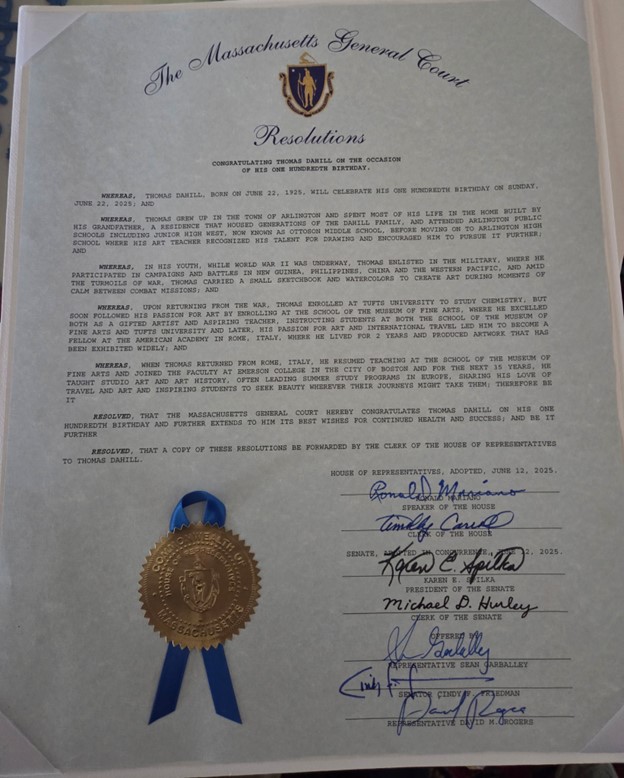
In June, Tom Dahill turned 100 years old and the Commonwealth of Massachusetts celebrated with a “Proclamation,” which was reproduced for us to enjoy by Howard Winkler. Betty Bigwood supplied an extra picture of Tom.
J Breen’s President Message is about the early history of 40 Market Street in Lowell and a quarrel associated with it. Lastly, one of your editors went on a Portuguese Cruise in June and shares her photos and feelings about being inside a lock.
As usual included are dates and pertinent information for events, directions to the museum and miscellany.
Enjoy!
Please contact us with any questions, suggestions, or concerns.
Your Editors
MCA Sponsored Events – 2025 Schedule
Fall Walk: 1:30pm, Sunday, October 19, 2025
Maple Meadow Aqueduct. Meet at kiosk, 35 Towpath Drive, Wilmington, MA 01887
Fall Meeting: 1:00pm, Sunday, October 26, 2025
Topic: Plans for new museum (see below)
Location: Reardon Room, 71 Faulkner Street, N. Billerica, MA 01862
Directors and Proprietors Only
Winter Meeting: 1:00pm, Sunday, February 15, 2026
Speaker and location TBA
The Visitors’ Center/ Museum is open Saturday and Sunday, Noon-4:00pm, except on a holiday (Easter). The MCA Board of Directors meets the 1st Wednesday of each month at 3:30pm, except July and August. Check the MCA website for updated information. After October 1, 2025, the Museum will be closed for a few weeks while the displays are moved from the current location to the new building at 2 Old Elm Street in North Billerica.
Fall Meeting: The Fall Meeting of the MCA will be held at 1:00pm on October 26, 2025 at the Middlesex Canal Museum and Visitors’ Center on 71 Faulkner Street in North Billerica, MA 01862. The meeting, in the Reardon Room, is for Directors and Proprietors only. MCA President J. Jeremiah Breen will lead members in a discussion of plans for the new museum at 2 Old Elm Street. This meeting, in all likelihood, will be the last meeting at the Faulkner Street location, which has served as the headquarters and museum for the MCA for nearly twenty-five years. Please join in the discussions for the new museum as you bid farewell to 71 Faulkner Street locale.
Directions to Museum: 71 Faulkner Street in North Billerica, MA
By Car
From Rte. 128/95
Take Route 3 (Northwest Expressway) toward Nashua, to Exit 78 (formerly Exit 28) “Treble Cove Road, North Billerica, Carlisle”. At the end of the ramp, turn left onto Treble Cove Road toward North Billerica. At about ¾ mile, bear left at the fork. After another ¼ mile, at the traffic light, cross straight over Route 3A (Boston Road). Go about ¼ mile to a 3-way fork; take the middle road (Talbot Avenue) which will put St. Andrew’s Church on your left. Go ¼ mile to a stop sign and bear right onto Old Elm Street. Go about ¼ mile to the bridge over the Concord River, where Old Elm Street becomes Faulkner Street; the Museum is on your left and you can park just beyond the bridge in the lot on your right. Watch out crossing the street!
From I-495
Take Exit 91 (formerly Exit 37) North Billerica, then south roughly 2 plus miles to the stop sign at Mt. Pleasant Street, turn right, then bear right at the Y, go 700’ and turn left into the parking lot. The Museum is across the street (Faulkner Street). To get to the Visitor Center/Museum enter through the center door of the Faulkner Mill and proceed to the end of the hall.
By Train
The Lowell Commuter line runs between Lowell and Boston’s North Station. From the station side of the tracks at North Billerica, the Museum is a 3-minute walk down Station Street and Faulkner Street on the right side.
President’s Message
Mr. Blood and Captain Kirk – The early history of the Market Building, 40 Market Street, Lowell
by J. Breen
“Mr. Blood owned a number of canal boats and employed a good many men in the business. He was called familiarly, on account I suppose of the alliterative initials of his name, “Old double B.” Mr. Blood was a man of great natural ability and business rectitude, but was somewhat obstinate in maintaining his opinions and on occasion was inclined to be irascible.
“Mr. Blood was a man of exemplary life – never used profane language, but would sometimes exclaim when excited or provoked, “Mighty thunder,” which was the nearest approach I ever heard him make to strong talk.
“Mr. Blood was a strong temperance man for the times, never using liquor himself, and discouraging its use by others. He used to make special contracts with his help in regard to the use of liquor while in his employment for the boating season. I remember, when a small boy, hearing a wrathful dispute between the old gentleman and one of his boat captains, named Kirk Howe, on the canal wharf, which arose out of one of these special contracts.
“Howe signed an agreement to work for Mr. Blood for the season, for $20 a month and board if he totally abstained from liquor. If he failed to totally abstain, he was to receive but $16 and board. Howe had come up the canal and had passed through the locks and down the river with his boat and cargo to the landing back of the Market Building in Lowell, where he unloaded. The day on which the quarrel occurred Mr. Blood learned in some way that Howe had been seen drinking liquor in D. L. Richardson’s cellar under Mansur’s building, that old-time eating house being quite near the city landing. Accordingly, the same afternoon, when Howe reached the head of the canal at Middlesex Village on his return trip, the old gentleman was in waiting, determined to test the truth of the information. Approaching Howe with his hand covering his eye, he said, “Here, Kirk, I want you to look in my eye and see if you can see what’s in it.” Howe took the lids of the old gentleman’s eye in his fingers, and separating them as far as possible, peered into the eye. “I can’t see anything, Mr. Blood,” said the unsuspecting Howe. “Look again Kirk” said Mr. Blood. Kirk again opened the lids and again peered into the eye. Before he reported the result of his last observation, the old gentleman started back exclaiming, “Kirk, I’ve got you now! You’ve been a drinkin’ rum. I suspected it before, I can smell your breath, and now I know it. It’s $16 a month and board and not one cent more now.” And then followed the wrathful quarrel which I heard. Howe abused the old gentleman shamefully with foul epithets, but the old gentleman was firm, and Howe had to stand by his contract, or lose his work for the remainder of the season.”
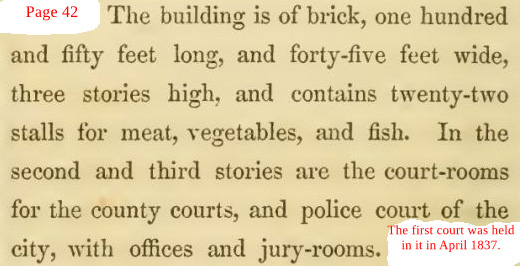
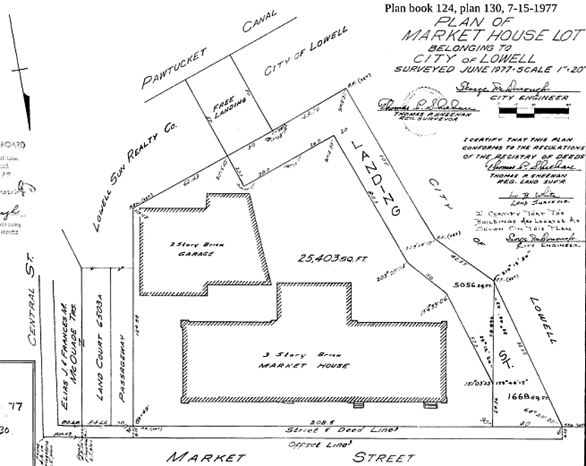
The above quarrel between Mr. Blood and Captain Kirk likely occurred in 1837 when Judge Hadley, born in 1831, was “a small boy”. The Market Building was completed in 1837. The quarrel occurred “at the head of the canal at Middlesex Village”. The head of the canal at the Merrimack River is today buried at 1703 Middlesex Street. The “landing back of the Market Building” where Captain Kirk unloaded his cargo is shown on the plan on the page following.
Henry Miles described the Market Building in 1845’s Lowell: As It Was, and As It Is as follows:
When Lowell was chartered as a town by the legislature in 1826, its commercial center was developing around the landing where canal boats traveling on the interstate water highway between Boston Harbor and Concord NH could unload after leaving the canal at Middlesex Village. The 27-mile Middlesex Canal between the Charles and Merrimack Rivers, completed in 1803, was the first part of the water highway to be built. John Hancock was the first proprietor of the canal.
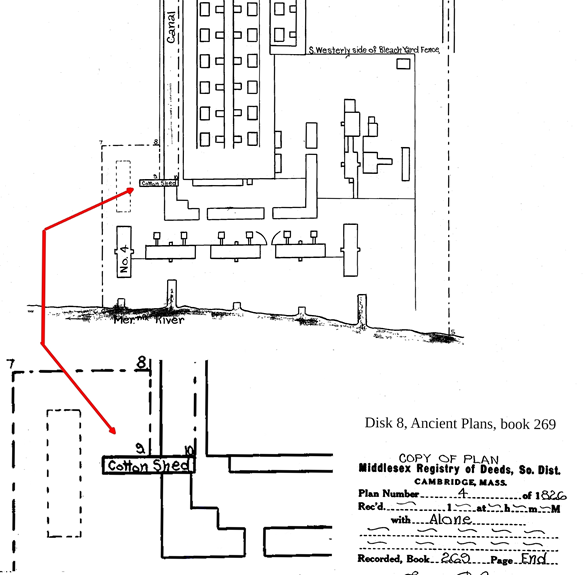
The Merrimack Manufacturing Company was incorporated in 1822. Henry Miles in 1845’s book on Lowell reported that the company was manufacturing “two hundred and fifty thousand yards of cloth per week, working up in that time fifty-six thousand pounds of cotton.” Before the railroad, the thousands of pounds of cotton were hauled from Boston Harbor on John Hancock’s canal.
Note the delivery shed built over the Merrimack Mills Canal in the 1826 plan.
References
1. Quarrel between Mr. Blood and Capt. Kirk in Samuel P. Hadley, “Boyhood Reminiscences of Middlesex Village”, Contributions of the Lowell Historical Society, 1911, Vol. 1, No. 2, pp. 180-285.
2. Rev. Henry A. Miles, Lowell: As It Was, and As It Is. Lowell: Powers and Bagley and N. L. Dayton, 1845, p. 48.
It’s Been a Long Time Coming
by Betty Bigwood
Farewell to 71 Faulkner Street. We plan to move at the end of October 2025 to 2 Old Elm Street. Our 11-year journey – from March 2014 when we accepted the 1876 woolen storage warehouse has been a long time coming. We were guided by donor William Donovan of Pace Industries and MCC Chairman Tom Raphael, through the first phases of this transfer. It was later taken over by the Middlesex Canal Association.
It will not be completed but it will be a usable building with heat and air-conditioning, electricity, plumbing and a sparse kitchen. We will then sort out our possessions to open in the New Year. It is an exciting time.
The Middlesex Canal Association was incorporated under the jurisdiction of Attorney Lou Eno in 1962 after the Billerica Historical Society was challenged to save the canal by a quest speaker. Initially meetings were held in member’s homes and church auditoriums.
MCC Chairman Tom Raphael assisted by Shayne and John Reardon and other devoted Billerica residents, Tom Dahill’s Collection of water colors, Ron Paré’s space in his mill building offered rent free and Rep. James R. Miceli sponsoring a $100,000 line item to pay the bills, we opened our Middlesex Canal Museum in the summer of 2001 where we have been located for the past 24 years. We leave with some sadness and carry away many good memories. We depart leaving a much-improved space for Ron Paré and his family whose kindness, support and generosity will be forever appreciated.
HOW LONG DID IT TAKE?
by Bill Gerber
 |
How long did it take to complete a trip on the canalized Merrimack River and Middlesex Canal? One popular belief claims four days down and five days back; but that, it appears, is relative to trips that originated in Manchester (formerly Derryfield) New Hampshire. Trips to/from Concord, another 25 miles each way on a swift flowing river and through another nine (or 12, early on) locks, no doubt added several more days.
Though slow by today’s standards, for most travelers, travel along the river and canal was not a lazy romp through a lovely, bucolic setting (though that may have been true for a very few, e.g., the Thoreau brothers and the occasional leisure excursion into the countryside). Then, as it is today in commercial and industrial operations, ‘time was money’. It is doubtful that professional boatmen spent much time admiring the scenery. To conduct their business they would have wanted to get where they were going, to do what they came to do in a reasonably short time, and return home expeditiously.
So, what’s a more realistic view? No doubt trip times varied considerably; but it should not be too difficult to develop reasonable estimates for each of the types of vessels that made the trip.
A related question is: how often did travelers need to avail themselves of hospitality resources provided at the lock keepers’ houses and taverns along the way?
The Packets:
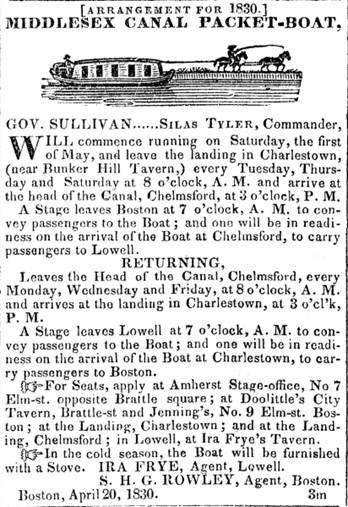
Although it routinely carried passengers and light freight, the primary purpose of the Middlesex Canal Company’s Packet, of course, was to conduct the company’s business; thus their boat typically only operated between Middlesex Village in Chelmsford and a point above the Mill Pond in Charlestown; though under special circumstances, the Packet was occasionally warped across the Charles River to the Boston side.1
Middlesex Canal Company regulations permitted Packets to travel at 3½ miles per hour.2 The Packet was permitted to pass all other boats and rafts proceeding in the same direction, and it had priority to move to the head-of- the-line at the locks and the one-lane aqueducts.
Disregarding current, which is negligible in a canal, at 3½ mph, it would have taken about 7¾ hours of straight running time to negotiate the 27½ miles of the Middlesex Canal in either direction. Add to this 2-2/3 or so more hours, i.e., the time spent negotiating the 16 locks en route, at perhaps 10 minutes per lock, plus still more time to rest, water and ‘swap out’ the tow horses, it appears that somewhat in excess of 10¾ hours would likely have been the best time for the Packet to make the trip, either way, between Charlestown and Middlesex Village.
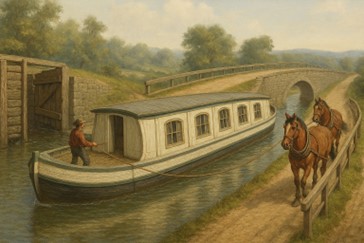 Canal Packet ChatGPT generated image Not historically accurate, do not replicate |
But the Packet’s schedule varied quite markedly over the decades that the Middlesex Canal was in operation. Early on, one report claimed that it took 12 hours to descend the-canal from Middlesex Village, and 18 hours to ascend from Charlestown. Another report claimed 8 hours down and 12 back.3 In each of these cases, if reflective solely of travel time, neither of the differentials for the up and down times nor the overall time to traverse the canal sound entirely reasonable.
One factor may account for some of the differences; the regulations required boats ascending the canal to summit level (i.e., the level of the Concord River in Billerica) to yield to other craft descending. Was this regulation imposed on the Packet? In the earlier years it appears that it may have been and, depending upon the amount of down-bound traffic, this could account for a small portion of the considerable time differences between trips up, verses those down the canal.
Such trip times likely also included business stops at, at least, some of the company’s Lock sites and Landings. The boats may also have stopped for meals at one or another of the lock-keeper’s houses or taverns along the canal; but such detail has long faded from the historical record.
Tay’s tavern, on the Woburn-Wilmington line near the mid-point of the canal, is thought to be where the Packet’s ‘spent’ tow-horses were exchanged for a ‘fresh’ team, both ascending and descending the canal; and travelers may have dined there as well.
Horn Pond House might also have been a routine stop.
|
Shown at the beginning of this article is an often published advertisement for the ‘Packet’ that served the canal – traveling in one direction on one day, and back the next. As noted, the Packet traveled between Middlesex Village and Charlestown, i.e., definitely not on the Merrimack River.4
A long serving schedule is described in that advertisement; it cites seven hours each way, ascending and descending the canal. It is unlikely that any unnecessary stops were made on this schedule. And, as posted in the advertisement, we know that the Packet ‘cheated’, i.e., that it routinely broke the speed limit. That the Packet (towed by two splendid horses harnessed in tandem5) had to exceed the allowable speed for travel on the canal (3½ mph for Packets) to make that advertised schedule was discussed in the article “Scofflaws on the Canal”.6 As calculated, to transit the 27 mile length of the canal in the advertised time, a sustained pace greater than 5 mph would have been required, plus each of 16 locks would need to have been filled or emptied to optimum level and the gates opened by the lock keepers to minimize the time for the Packet to lock-through.
It would have been a very rare event if Packet passengers ever needed to overnight at a Lock Keeper’s house or Tavern along the way.
Luggage Boats:
The foregoing description is less relevant for luggage (freight) boats. Typically towed by a single horse, luggage boats were allowed to proceed at 2½ mph, (half the actual speed of the Packet in later years). At this rate it would take them about 11 hours just to negotiate the 27½ mile channel. Ten or so minutes to pass through each of the 16 locks would add at least another 2-2/3 hours, bringing the trip time to about 14 hours. Add to this that, from time to time, no doubt they waited at some of the locks and the one-way aqueducts until other boats and/or rafts cleared, and they yielded to other boats ascending to summit level. On top of all this, the crew needed to stop to eat and to feed, water and rest their tow animal.
At best, it would take the longest of summer days and the best of circumstances for a luggage boat to negotiate the entire length of the Middlesex Canal in one day. Almost certainly, any Luggage Boat crew that did not get started at the crack of dawn on a mid-summer day of travel would need to avail themselves of hospitality resources for at least a one night stay somewhere along the canal (or they may have elected to sleep on or near their boat, which, no doubt, was sometimes done.) Likely, in actual practice, an end-to-end trip typically took at least a day-and-a-half.
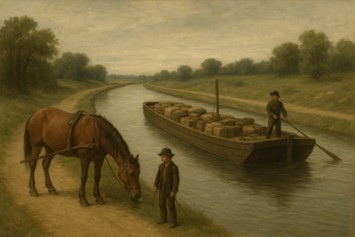 Luggage Boat, paused ChatGPT generated image Not historically accurate, do not replicate |
As for negotiating the Merrimack, how should we interpret the ‘four days down, from Manchester NH, and five days back’, noted earlier?
If we assume that, with the additional time needed to turn in or acquire a tow horse at Chelmsford’s Merrimack flight of locks, negotiate the locks, and re-rig the boat for-or-from travel between the river and the canal, then the actual time spent on the Middlesex might routinely have amounted to the best part of two days each way. Assuming this was true, then it would seem that Luggage Boats descending by rowing with the current (and occasionally sailing the lake behind Pawtucket Dam!), and negotiating the nine locks of the bypass-canals around falls and rapids along the river, must have taken the best part of two days down. Ascending the river, largely by poling and sometimes rowing the boat (if not towed part way by Mr. Sullivan’s steam towboat), and negotiating the same nine locks, would have taken the best part of three days. — To and from Concord NH, the boats would have had to negotiate another nine (or 12, early on) locks (including one guard lock) each way. No doubt this added several additional days to the trip.
Log Rafts and ’Bands’ of Rafts
An initial stated purpose of the canal was “to open up the hitherto inaccessible timber and farm lands in northern Massachusetts and New Hampshire in order to enlarge the trade of Boston.”7 It appears unlikely that the timber was inaccessible. Free log drives seem to have been in use well before the Merrimack River and Middlesex Canals were available. But once they were available, during less than spring freshet water level conditions, and to minimize damage from a rocky river, some of the harvested timber was brought down in rafts, though many of these were taken all the way to tidewater, skirting Pawtucket Falls by taking the same named canal, then on along the coast to Boston and environs.
In the very early days it appears that many raftsmen avoided the Middlesex Canal. Of those that did travel it, probably not all of their bands of rafts made it all the way through to Charlestown intact, though many obviously did. Likely some rafts were sold off to sawmills along the way to meet the needs of local towns and villages. And there were needs to be met - Chelmsford, Billerica, Wilmington, Woburn, Medford and Charlestown all had saw mills to provide local lumber, including a tidal powered mill at Medford, though that one might well have been supplied with timber from the ocean side.8
There were two families in Middlesex Village who rented oxen to tow bands of rafts down the canal. These could be ‘hired’, along with a ‘driver’ or two, harnessed (almost certainly in tandem, rather than side-by-side, so as to be able to negotiate narrow sections of the towpath, e.g., around bridge abutments and the narrower towpaths along the sides of aqueducts) and brought to the canal ready to be hitched up to the band as soon as all the rafts could be brought up from river level and reassembled into a band.
This arrangement had to be made before the rafts transited the Merrimack Flight; i.e., there were strict rules: “Nor shall any Boat or Raft, not belonging to the Proprietors, be received into the Canal, until the owner shall have oxen or a horse or horses ready to draw the same on immediately.” 9
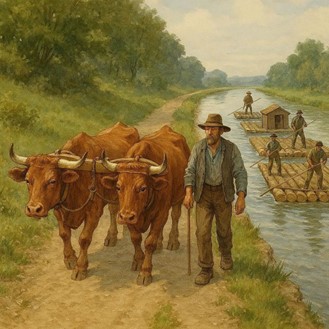 Band of Log Rafts Under Tow MS Bing Image Creator Image Not Technically Accurate, do not replicate |
Keep in mind too that rafts had the lowest priority on the canal, both the luggage boats and the Packets could pass them, etc.
Doing the math for a band of rafts traveling down the Middlesex Canal is a bit of a challenge. The easy part - at 1½ mph it would have taken in excess of 18 hours for any number of rafts just to negotiate the water channel.
The time for a band of rafts to negotiate the locks depended on the number of rafts to be brought down the canal. Consider a band of five rafts arriving at the base of the Merrimack Flight, i.e., a three-lock ‘staircase’ at Chelmsford’s Middlesex Village. In the basin at river level, the band would be disassembled into individual rafts to begin the ascent.
Getting a raft, or a boat, into a lock was not a trivial task, each one could weigh three to five times the weight of a luggage boat. Also options for moving a raft were constrained - the canal company posted rules “poles pointed with iron shall not be used in guiding Boats and Rafts into the Locks; but they shall either use poles without any iron on them, with which to fend off from the gates, or the Boatman shall step out with the head rope, or painter, and check the way of the Boat [or raft], and prevent her from striking the gates.” 10
Arbitrarily assume that it might take five minutes to draw the first raft into the bottom lock, to snub its forward momentum so that it did not bash the gates at the opposite end, and to close the entry gates. Then five minutes more to fill that lock from the middle lock above it, five more to move the raft into the middle lock, and five to drain that bottom lock back down to river level; all the while the middle lock was being filled from the upper lock. It would be 20 minutes before the second raft could start its journey up. And 20 minutes more for each raft thereafter. Then at least another half-hour would pass while the last raft propagated up and eventually cleared the top lock. Overall, it probably took on the order of three hours for all five rafts just to ascend that flight; assuming, of course, that there were no boats ascending or descending that would have interrupted the flow.
Once at the top of the flight, the five rafts would be reassembled into a band, the towline from the oxen attached, then that part of the journey would begin. It was five miles in the clear to the next hurdle.
Next, consider the Concord River crossing. Initially (from 1804 to about 1809), facilities there consisted only of a standard length guard lock on each side of the river, and a narrow floating towpath to bridge the river; the latter initially being inadequate to carry the weight of a tow animal.
There would be days when the river level and the canal level were the same, perhaps on both sides of the river. On those days both the upper and lower gates of the guard locks on both sides could be left entirely open. Thus the oxen might tow a band up to and perhaps part way through the guard lock. Then, while the oxen were led around and over the foldaway to the east side of the river; on the pre-1810 floating towpath the raftsmen would likely manually tow a raft at a time from the west-side guard lock, across the Concord River (on the slack-water pool created by the summit- level dam) and into the-side guard lock on the east side. As each of the rafts were been brought over, they would be reunited into a band, eventually the oxen reattached, and the journey would resume. Needless to say, it was a time-consuming process.
But on those days when the river was higher, the bands of rafts would be brought near to the west-side guard lock and the ‘band’ disassembled into individual rafts. Likely one ox would tow the first raft into the guard lock, whereupon its elevation would be raised slightly to the level of the river. Then one or more of the raftsmen (human crew) would need to extract that raft from the lock and tow it across the river to and into the guard lock on the east-shore. Once in and the gates closed, the elevation would again be adjusted, this time from the Concord River level down to the level of the canal on the east-side of the river. When that had been completed, likely the second ox, which, in the meantime, had been led around to the east side, crossing at the ‘ford-way’ (maybe an eighth of a mile upstream of the towpath) would extract the raft from the lock and tow it a short distance ‘down the canal’ to await the arrival of each successive raft, to create a new ‘band’ as each raft was individually brought across the river. And this process would be repeated for each of the rafts of the ‘band’ that started down the canal. How much time would this have taken? Some indications are - more than a day.
This changed considerably in about 1809. Reporting to the Proprietors in 1810, John L. Sullivan, Agent for the Canal, stated: “The floating bridge over the Concord River was originally built slightly. The horses belonging to boats and rafts, were necessarily conducted some distance round; while the men often with much difficulty were getting the boats or rafts across. This floating bridge requiring to be almost renewed, I thought it best to add another range of logs, and plank it wide enough for the horses to tow the boats over at once.” - “The gates to form the Raft Locks, I consider an important improvement in its immediate consequences.” 11 The “gates to form the Raft Locks” to which he referred were placed 670 feet from the top gates at the guard locks on either side of the river, thus entire bands could be drawn into this vastly oversized lock; raised to river level by water fed directly from the river, then the oxen could tow the entire band across the river and into the Raft Lock on the east side, where the entire band could be lowered to the level of the canal there, and the band could then proceed totally intact through the entire process. How much time would this take?
The time to transit locks further along the canal might have been shortened if one or more of the rafts could be sold-off at this point, to be sawn-up by either of the two saw mills that existed at the Concord River crossing. These mills provided lumber: to serve the needs of the canal company itself; to supply an enterprise there at the crossing that apparently constructed boats for use on the river and canal; and by statute of the legislature to supply the people of Billerica; and very possibly for Chelmsford, Concord and Wilmington, all of which could have been provided with bulk lumber transported inexpensively by boat. Rafts so destined to be sawed up were likely ‘stored’ in Timber Cove (on the east side of the river, upstream of the ‘peninsular portion of the towpath’) until either of the mills were ready for them.
Thereafter, as the band encountered each succeeding lock, consider that the time for the first raft to enter a lock, to be lowered to the next level, to exit that lock, the gate closed and the water level to be raised to accept the next raft, so that the time for the second raft and each raft thereafter to enter each of the single locks en route, of which there were 14, would have taken on the order of 20 minutes per raft, with another 15 minutes for the last raft to enter, be lowered and to clear the lock. Where two-lock ‘stairs’ were encountered, of which there were four, probably 25 minutes for the last raft to enter the top lock, descend to the level of the second lock, enter that lock, descend again, then clear the bottom lock.
Since no traffic was allowed to travel during the hours of darkness, add in still more time for multiple overnight stays; perhaps 12 hours for each 12 hours of travel, which would have included time to feed the crew and care for the animals.
Obviously the length of time for a band of rafts to transit the Middlesex Canal could vary considerably. Shown below is a table of what the times might have been for a band of five rafts to transit the Middlesex Canal, assuming that everything worked in their favor.
Time for a Band of Five Rafts to Transit the Middlesex Canal
| Estimated Time Needed to: | Before Raft Locks | After Raft Locks |
| Transit Canal Length | ≈18 hours | ≈18 hours |
| Acquire Tow Animals | ≈4 hours | ≈4 hours |
| Ascend Merrimack Flight | ≈3 hours | ≈3 hours |
| Pass Concord Crossing | ≈12 hours | ≈2 hours |
| Descend Ten Single Locks @ 2/ | ≈20 hours | ≈20 hours |
| Descend Four Double Locks @ 2.25/ | ≈9 hours | ≈9 hours |
| Overnight on the Canal | ≈60 hours | ≈48 hours |
| Estimated Total Time | ≈126 hours | ≈103 hours |
If raftsmen did not arrange to live aboard their rafts, they would have been heavy users of the hospitality facilities offered by the lock keeper’s houses and taverns along the way.
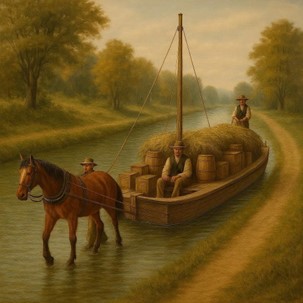 |
About the Merrimack - Given that rafts of logs could originate from any point along the river, ranging from the White Mountains almost to the entrance to the Middlesex Canal, that the rafts (which traveled with the flow of the river) might be brought down on the swiftly flowing waters of spring freshets, or during periods of normal flow, and in either case had to negotiate the slack water lakes behind the several larger dams (Garvin’s Falls, Hooksett, Amoskeag, and Pawtucket), that during the freshets they might have passed over the dams of many of the river canals, but during normal flow probably passed through each and every one of them, it seems overwhelming to try to develop an estimate for the time of travel.
About the images, author’s note: As may be apparent, I have attempted to use Artificial Intelligence to generate images to illustrate the several sections of this article - with mixed results. I have concluded that either the various AI tools do not know much about early 19th century canal transportation history and practice - or I have yet to discover the key to unlock that knowledge!
Efforts to generate images that were historically acceptable and technically accurate seemed much like trying to ‘program’ the image. In my initial efforts I had great difficulty getting the tow animals off the boat or raft, or out of the water in front of the boat or raft, or of getting the boat or raft off the towpath. Eventually detailed and carefully ordered scene description rewrites surmounted these problems. But similarly, early attempts to generate an image of a Packet resulted in boats that looked very much like a present-day British Narrowboat. And I have yet to learn how to generate the flat-bottomed, slab-sided, scow-ended type of luggage/freight boat that were used on the M’sex Canal. None of the AI environments understand that a canal boat’s towing mast is not a sailing mast, that the towing mast must be short enough to pass beneath the bridges along the way. Similarly they do not understand that when multiple tow animals are used they must be harnessed in tandem, not side-by-side, to allow them to negotiate the narrow towpath sections around bridge abutments and along aqueducts.
It’s tough to find an acceptable substitute for the exceedingly talented and educated artist that the canal association has so long enjoyed. All of these are obstacles that I believe can be overcome with time and tenacity, but alas, thankfully, for now, I’ve run up against TT’s time limit!!
Notes:
1. It appears there were times when the company’s Packet was ‘warped’ across the Charles River, to the Boston side. See: Dettinger, David, The Canal that Bisected Boston, http://www.middlesexcanal.org/towpath/towpathtopicsMar2008.htm#boston, figures 1 & 2.
2. Speeds much faster than this caused the wake from the bow to curl. This tended to scour the bank, which would, over time, silt-up the canal; conditions that were much ‘frowned upon’.
3. Lawrence, Lewis M., “The Middlesex Canal”, page 98
4. There are indications that a Packet did operate on the Merrimack for a short time, towed by J.L. Sullivan’s 1816 towboat. Would that have been the canal company’s Packet? Not likely.
5. Typically, two or more tow animals were harnessed in tandem, vs side-by-side, to enable them to negotiate: the very narrow towpaths around bridge abutments and along aqueducts, to cross the floating towpath across the Concord River, and to pass other tow animals.
6. Gerber, Bill, Scofflaws on the Canal, http://middlesexcanal.org/towpath/towpathtopicsApr2010.htm
7. The Middlesex Canal, Mary Stetson Clarke, Chapter 1 page 11
8. ChatGPT search for saw mills in towns along the Middlesex Canal, from 1804 to 1852.
9. The Middlesex Canal, Lewis M. Lawrence, p 42
10. The Middlesex Canal, Lewis M. Lawrence, p 45; from footnote 52 - Middlesex Canal Records. Original records of the proprietors. Then at the Office of Engineer of Middlesex County, Court House, East Cambridge, now at Mogan Cultural Center, Lowell National Historical Park.
11. The Middlesex Canal, Lewis M. Lawrence, p 58.
About Tom Dahill
by Howard Winkler
Representative Sean Garballey of the 23rd Middlesex District along with Senator Cindy Friedman and Representative Dave Rogers initiated a Resolution from the General Court to honor Tom Dahill.
WHEREAS, Thomas Dahill, born on June 1, 1925, will celebrate his one hundredth birthday on Sunday, June 22, 2025: and
WHEREAS, Thomas grew up in the town of Arlington and spent most of his life in the home built by his grandfather, a residence that housed generations of the Dahill family, and attended Arlington Public Schools including Junior High West, now known as Ottoson Middle School, before moving onto Arlington High School where his art teacher recognized his talent for drawing and encouraged him to pursue it further, and
WHEREAS, in his youth, while World War II was underway, Thomas enlisted in the military, where he participated in campaigns and battles in New Guinea, Philippines, China and the Western Pacific, and amid the turmoils of war, Thomas carried a small sketchbook and watercolors to create art during moments of calm between combat missions, and
WHEREAS, upon returning from the war, Thomas enrolled at Tufts University to study chemistry, but soon followed his passion for art by enrolling at the School of the Museum of Fine Arts, where he excelled both as a gifted artist and aspiring teacher, instructing students at both the School of the Museum of Fine Arts and Tufts University and later his passion for art and international travel led him to become a fellow at the American Academy in Rome, Italy, where he lived for 2 years and produced art work that was exhibited widely, and
WHEREAS, when Thomas returned from Rome, Italy he resumed teaching at the School of the Museum of Fine Arts and joined the faculty at Emerson College in the City of Boston and for the next 15 years, he taught Studio Art and Art History, often leading summer study programs in Europe, sharing his love of travel and art and inspiring students to seek beauty wherever their journeys might take them, therefore be it
RESOLVED, that the Massachusetts General Court hereby congratulates Thomas Dahill on his one hundredth birthday and further extends to him the best wishes for continued health and success, and be it further
RESOLVED, that a copy of these resolutions be forwarded by the Clerk of the House of Representatives to Thomas Dahill.
House of Representatives, Adopted, June 12, 2025
Speaker of the House, Ronald Marino
Clerk of the House, Timothy Carroll
Senate, Adopted in Concurrence, June 12, 2025,
President of the Senate, Karen E. Spilka
Clerk of the Senate, Michael D. Hurley
Offered by Representative Sean Garballey
Senator Cindy F. Friedman
Representative David M. Rogers
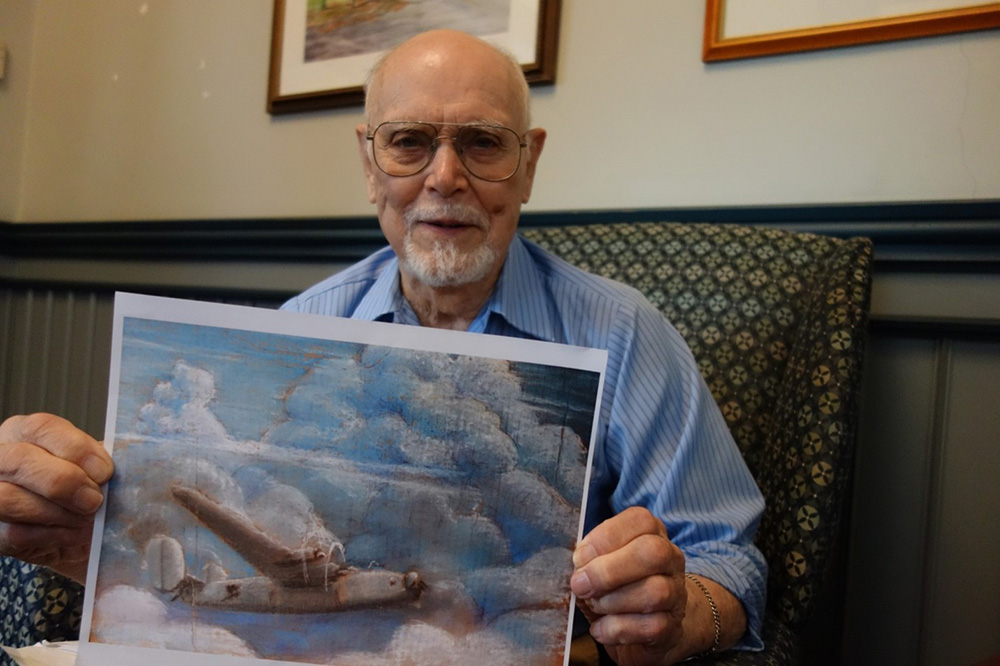
Tom Dahill with a picture of the B-24 he piloted in WW II
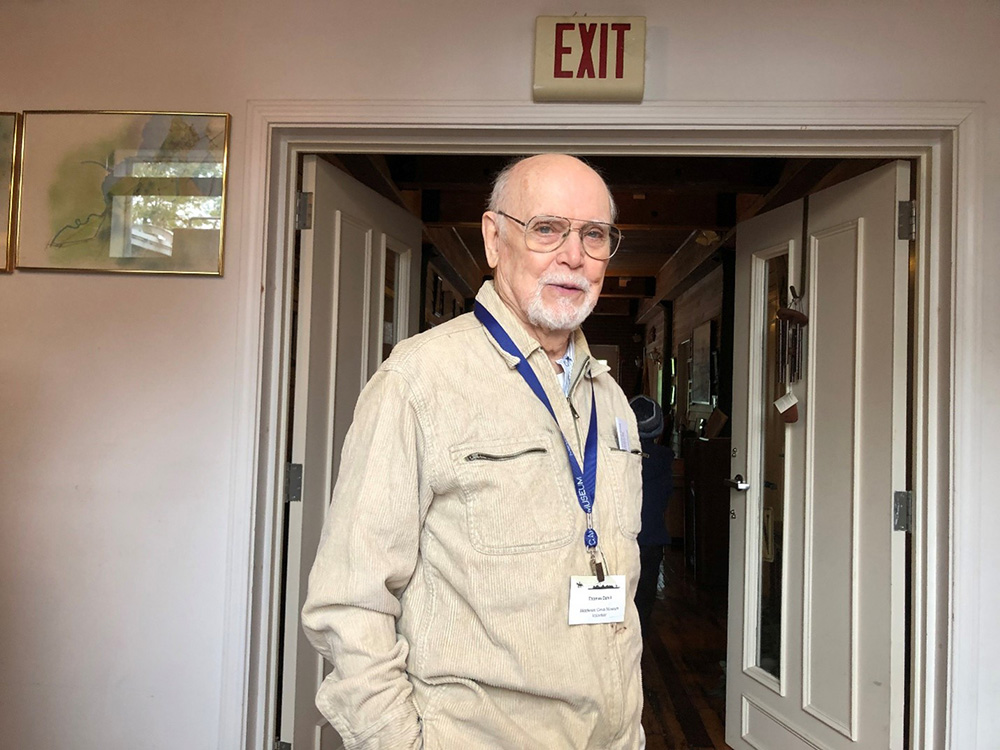
In an undated photograph, Tom Dahill at the entrance to the original Canal Museum at 71 Faulkner Street in North Billerica.
Courtesy Betty Bigwood
Portuguese Lock
by Debra Fox
Having spent many years reading about locks, looking at locks, and guiding boats through the Visitor’s Center locks, I was not prepared for the feeling of being INSIDE a lock!
Portugal is a narrow north/south country with its major river flowing east/west. In 1962 there was a flood of massive proportion – double digit feet above its banks. To harness the river and prevent further flooding again on that scale, a major project was begun to create locks and harness the river’s power into electricity.
This is not a travelog or a detailed description of the structures. My goal is to show in photos the massiveness of 20th century construction and technology and get, you the reader, to compare it to our Middlesex Canal locks: stones and iron versus concrete and steel.
Sitting on the boat deck and rising to the next level of the river was an amazing sensation and that massive concrete would never feel the claw of the muskrat! FYI the countryside was hilly and covered with vineyards and beautiful buildings. Go if you have a chance!
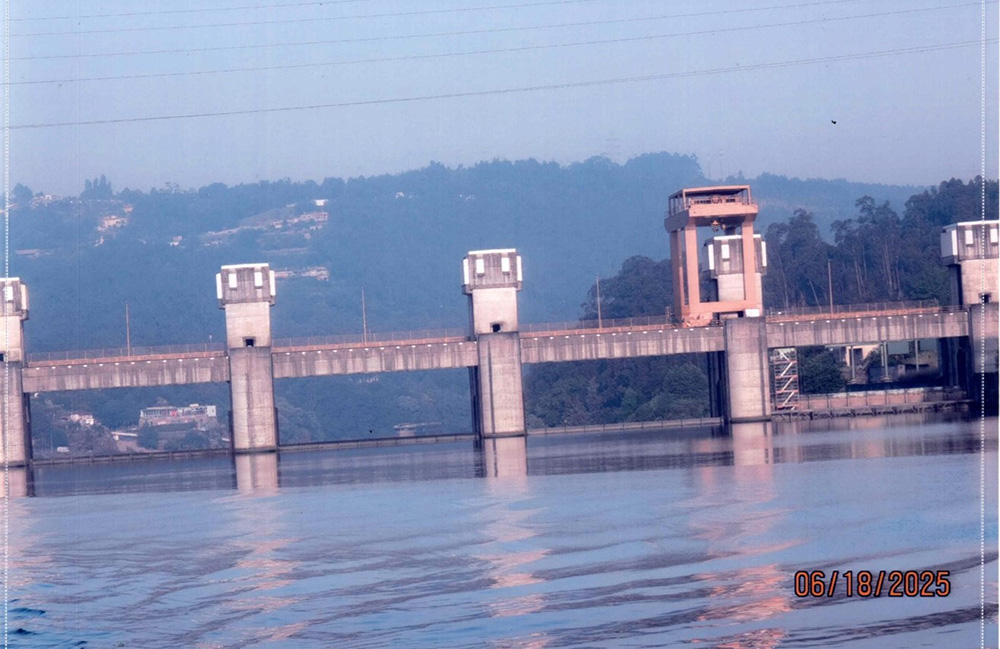
Approaching a Lock – looks like it falls off to nothing.
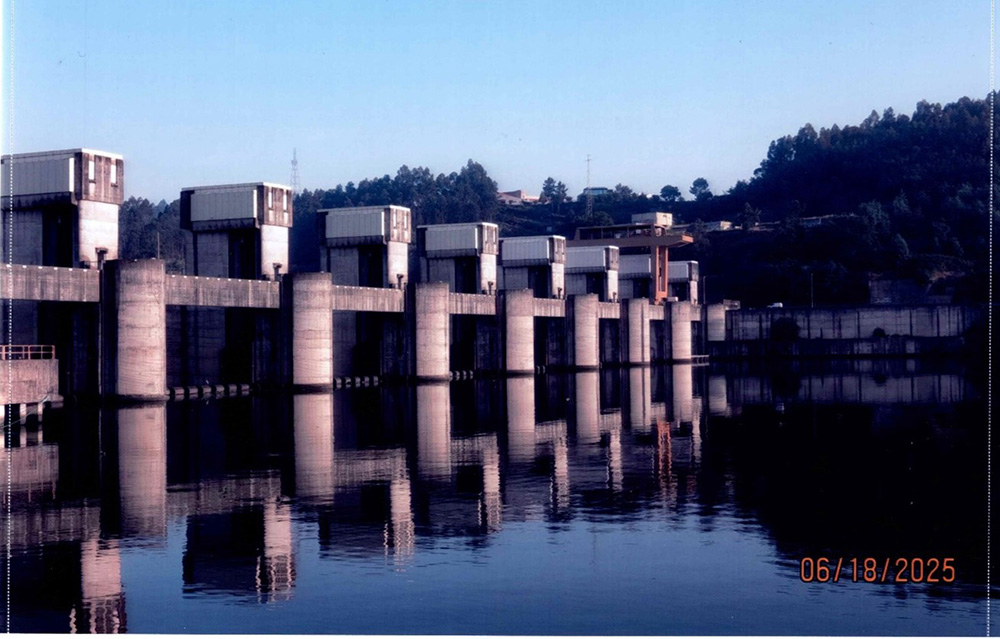
Looking back at the lock
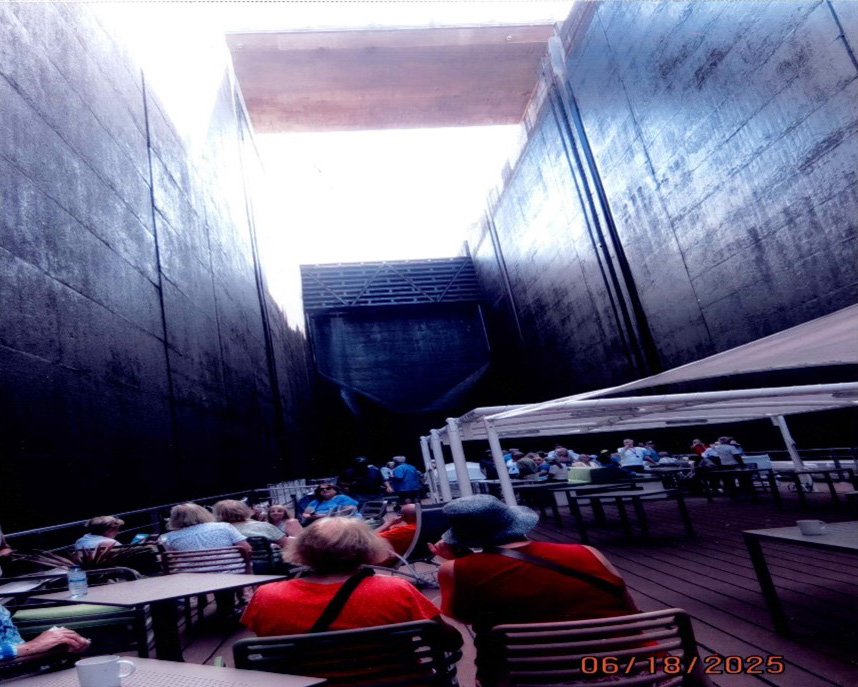
A view from inside a lock rising to the top. Note the massive concrete and steel walls.
The British are Coming!
On July 30, 2025, the Right Honorable Richard Holden visited the Middlesex Canal Museum. He is a member of the British Parliament serving in the house of Common representing among other English towns, Billericay. While conducting business in Boston, he realized Billerica, Billericay’s sister town, was only a short train ride away.
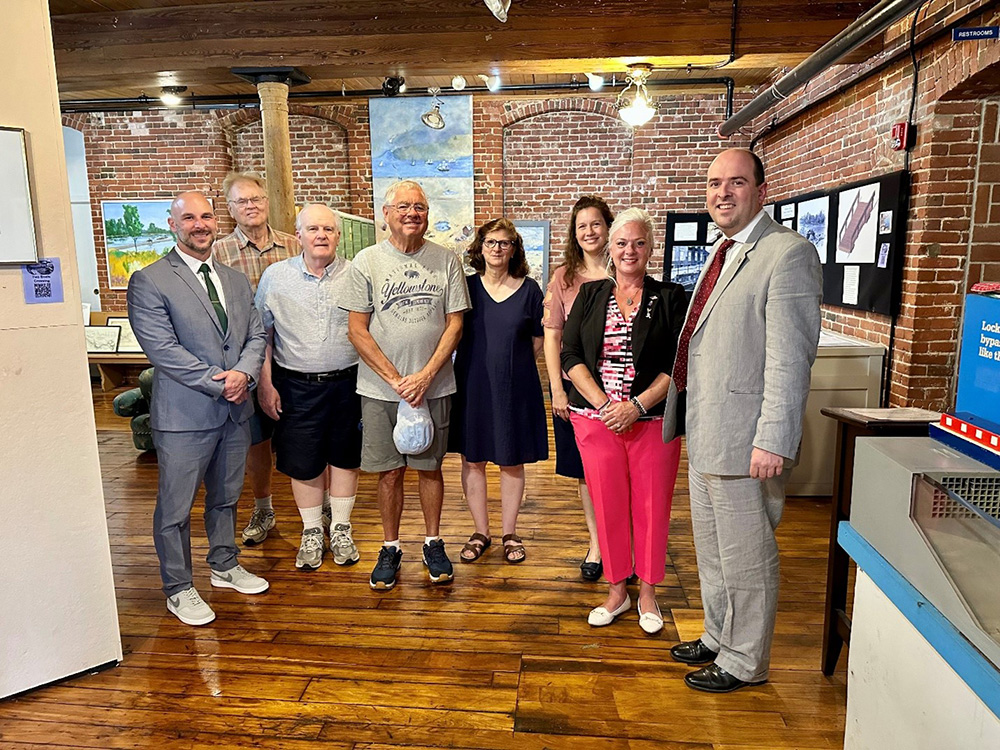
From Left to Right: Mark Lombardo, Billerica State Representative; J Breen, Middlesex Canal Association President; Alec Ingraham, Billerica Historical Commission Chairman; John Bartlett, Billerica Historical Society President; Michele DeParasis, Billerica Historical Society Board Member; Katherine Malgieri, Billerica Director of Planning and Community Development; Dina Favreau, Billerica Select Board member; Right Honorable Richard Holden. Photo Courtesy of Mary Leach
Editors’ Quiz
Towpath Topics is packed with information about the Middlesex Canal that cannot be found elsewhere. If you can answer these questions, you will not win a prize, but you are an avid MCA newsletter reader. If you cannot answer them, they can all be found in back issues of Towpath Topics which were archived on the Middlesex Canal Association website by webmaster, Robert Winters.
Answers will appear in the next issue.
MISCELLANY
Back Issues – More than 60 years of back issues of Towpath Topics, together with an index to the content of all issues, are also available from our website http://middlesexcanal.org/towpath. These are an excellent resource for anyone who wishes to learn more about the canal and should be particularly useful for historic researchers.
Estate Planning – To those of you who are making your final arrangements, please remember the Middlesex Canal Association. Your help is vital to our future. Thank you for considering us.
Membership and Dues – There are two categories of membership: Proprietor (voting) and Member (non-voting). Annual dues for “Proprietor” are $25 and for “Member” just $15. Additional contributions are always welcome and gratefully accepted. If interested in becoming a “Proprietor” or a “Member” of the MCA, please mail membership checks to Neil Devins, 28 Burlington Avenue, Wilmington, MA 01887.
Middlesex Canal Association Officers and Directors: http://www.middlesexcanal.org/directors.htm
Museum & Reardon Room Rental – The facility is available at very reasonable rates for private affairs, and for non-profit organizations to hold meetings. The conference room holds up to 60 people and includes access to a kitchen and restrooms. For details and additional information please contact the museum at 978-670-2740.
Museum Shop – Looking for that perfect gift for a Middlesex Canal aficionado? Don’t forget to check out the inventory of canal related books, maps, and other items of general interest available at the museum shop. The store is open weekends from noon to 4:00pm except during holidays.
Web Site – The URL for the Middlesex Canal Association’s web site is www.middlesexcanal.org. Our webmaster, Robert Winters, keeps the site up to date. Events, articles and other information will sometimes appear there before it can get to you through Towpath Topics. Please check the site from time to time for new entries.
The first issue of the Middlesex Canal Association newsletter was published in October, 1963.
Originally named “Canal News”, the first issue featured a contest to name the newsletter. A year later, the newsletter was renamed “Towpath Topics.”
Towpath Topics is edited and published by Debra Fox, Alec Ingraham, and Robert Winters.
Corrections, contributions and ideas for future issues are always welcome.